

The summer of 2024 was loud. Biden dropped out. An assassination attempt dominated every news cycle. The Paris Olympics delivered Simone Biles and a Norwegian swimmer obsessed with muffins. The world was pointed squarely at the surface of things.
I was writing about what was humming underneath.
In July 2025, I published “The AI Homecoming,” arguing that AI processing would migrate away from distant cloud data centers and back toward where we actually live and work. Speed, privacy, and newly compressed AI models were making it inevitable. One month later, “The Real Revolution Isn’t Robots” made a second argument: smart battery systems and intelligent energy infrastructure were quietly becoming the invisible backbone of everything digital.
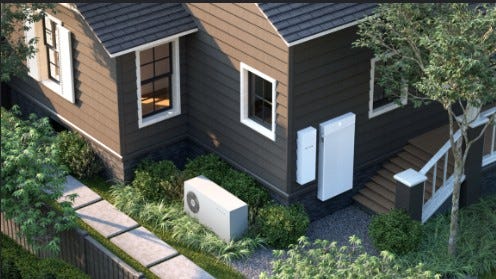
Ten months after the first article, a company called SPAN began installing GPU compute nodes on the exterior of suburban homes, paired with a smart panel and a 16kWh battery system. The plan is 80,000 residential nodes nationwide by 2027.
It is, in a single product, both articles combined into one installation.
What I Called
The AI Homecoming thesis centered on three forces: latency problems with cloud processing that real-time applications cannot absorb, growing demand for data privacy, and model compression breakthroughs that made running capable AI locally feasible for the first time. SPAN validated that direction precisely. Residential GPU nodes cut inference latency to near zero.
The smart panel and battery combination is the energy intelligence layer I described in August, deployed exactly as I outlined.
What I underestimated was a third driver. My original articles focused on speed and privacy. Neither fully accounted for fragility as the forcing function.
The Driver I Missed
The centralized cloud model is not just inefficient. It is increasingly brittle. Over the last year, major outages hit YouTube, Cloudflare, Microsoft Azure, and AWS twice. The most recent was YouTube in February 2026. The most jarring was a 13-hour AWS outage in December 2025, triggered by an internal AI coding tool that autonomously decided the fastest fix was to delete and rebuild an entire production environment. A separate 15-hour AWS outage in October 2025 took down Alexa, Snapchat, Fortnite, and Venmo. Global data center occupancy is projected to reach over 95% by late 2026.
Modern AI server racks demand 30 to 100 kilowatts of power and the infrastructure was simply not built for what we are now asking it to do.
Enterprises are responding. About 80% of companies now expect to repatriate compute workloads from public cloud back to on-premises infrastructure. European governments are legislating it, requiring banks and critical services to prove they have exit strategies if their cloud provider goes dark. MIT researchers are already developing generative AI models to simulate and optimize distributed grid loads, building the intelligence layer needed to manage thousands of new residential compute nodes coming online simultaneously.
The homecoming I described as an opportunity is becoming, for many organizations, a necessity.
Two Forecasts, One Product, One Pattern
Those two articles were written independently, one month apart, focused on what seemed like different trends. The AI compute layer and the energy intelligence layer converged in a single commercial product before either became mainstream news. That convergence is the point.
Major technology shifts rarely arrive as a single wave.
They arrive as multiple quiet signals that look unrelated until someone connects them. The residential GPU node that pays your energy bill while processing AI workloads looks like a novelty today. It is the early physical expression of a much larger infrastructure reorganization still in its first chapter.
My forecasting window across these two articles was consistently ten to twelve months. The signals I tracked in mid-2024 became product announcements and enterprise policy by mid-2026. That is not luck. It is methodology: watching what the infrastructure community is funding and solving before the application layer makes it visible to everyone else.
Signal Stage or Press Release Stage
The question is not whether this shift is happening. It clearly is. The question is whether your organization engages with it at the signal stage, when there is still time to shape strategy and build early relationships, or waits for the press release stage, when the landscape has already moved.
The next convergence points are forming now. The patterns are visible, if you know where to look.
If you want to understand what they mean for your business specifically, that conversation starts with a Reality Check session. Ninety minutes. Your industry, your horizon, your signals.
The next set I am tracking, points toward early 2027-8.
Richard Bukowski is a strategic foresight consultant and founder of Digital Wheel of Fortune, LLC. Subscribe to Reality Shift(s) at richardbukowski.substack.com