
The New Cambrian Explosion: Why Computer Vision Will Reshape Everything


The Darkness Before Sight
Five hundred and forty million years ago, the oceans were full of light. Hydrothermal vents pulsed with energy. Life filled the water.
And yet nothing could see any of it. Not a single retina existed. Not one cornea, not one lens.
All that light, all that biological complexity, going entirely unwitnessed.
Then trilobites developed the first functional eyes. In evolutionary terms, what followed was nearly instantaneous. The Cambrian explosion produced an astonishing diversity of animal life in the fossil record. Biologists and paleontologists have debated the mechanism for decades, but the leading thesis is elegant in its simplicity: once something could see, everything changed. Predators could hunt. Prey could flee. Creatures could navigate, recognize, and respond. Perception created a new kind of reality. Sight did not just record the world. It transformed what organisms could do within it.
That origin story is not ancient history. It is the most accurate frame available for understanding what is beginning to happen in artificial intelligence right now.
Seeing Is Understanding
Stanford professor and AI pioneer Fei-Fei Li has spent her career making an argument that executives consistently underestimate. Seeing is not a passive act. It is the engine of intelligence itself.
Her framing: the nervous system did not evolve first and then develop vision as an add-on. Vision came first, and the demand for interpretation drove everything else. Sight required the brain to process geometry, spatial relationships, movement, depth, and consequence. Insight followed sight. Understanding followed insight. Action followed understanding. The entire architecture of biological intelligence is downstream of the moment something first perceived the world in three dimensions.
Li calls this spatial intelligence, and she argues we are only now beginning to replicate it in machines. This matters beyond academic interest. If spatial intelligence is what made biological minds capable of sophisticated action, then AI systems that lack it are fundamentally constrained. They can process. They can predict. But they cannot truly understand or operate within a physical world.
That constraint is exactly what a new wave of computer vision research is targeting.
We Have Been Building the Wrong Thing
Here is the uncomfortable thesis gaining traction among the researchers who matter most: the entire AI industry may have spent the last several years optimizing for the wrong architecture.
Every major AI system in commercial deployment today, from the chatbots on your customer service portal to the large language models your teams use for analysis, operates the same way. They generate output token by token, left to right, predicting the next word based on everything that came before. They are extraordinarily sophisticated text predictors. They think in language because language is the substrate of their cognition.
Yann LeCun, the Turing Award-winning researcher who spent years as Meta’s chief AI scientist, has argued for years that this is a fundamental mistake. Language is not intelligence. It is an output format. The actual work of understanding happens at a deeper level, in what researchers call latent space, where meaning exists independently of the words used to describe it.
Consider this four-year-old comparison. A child who has been alive for four years has absorbed more information about physical reality by simply watching the world than the largest language model trained on every text document humans have ever produced. All the books, websites, all academic papers, all the conversations ever written down. A toddler beats the model, because the real world contains exponentially more information than language can ever capture.
The research paper that crystallized this argument is VL-JEPA (Vision-Language Joint Embedding Predictive Architecture). Where current vision models analyze frames independently and output text descriptions, VL-JEPA builds a continuous internal understanding of what is happening across time. It does not narrate. It comprehends. It thinks in meaning first, and only uses language when communication requires it. Early benchmarks show it outperforming models with vastly more parameters on vision tasks, which suggests that architecture matters more than scale.
If this research direction proves out, the implications extend well beyond academic papers. The organizations that have structured their AI strategies entirely around language model capabilities are working from a map that may already be outdated.
The Internet of Eyes Is Becoming Infrastructure
The shift from theoretical to commercial is already underway. LDV Capital founder Evan Nisselson coined the term “Internet of Eyes” nearly a decade ago, forecasting a world where visual sensors embedded in every environment would collect and exchange data at a scale previously unimaginable.
That forecast has arrived.
Peloton’s new IQ coaching system uses on-device computer vision to track movement in real time, delivering form correction, rep counting, and personalized training guidance without a human instructor present. The camera is not an accessory.
It is the product.
Amazon has deployed AI-powered smart glasses for delivery drivers that layer augmented reality navigation, package scanning, and hazard detection directly into the driver’s field of view. The next generation, already in development, will identify obstacles, confirm correct drop-off locations, and respond to the physical environment in real time.
This is not a gadget pilot. It is workforce infrastructure.
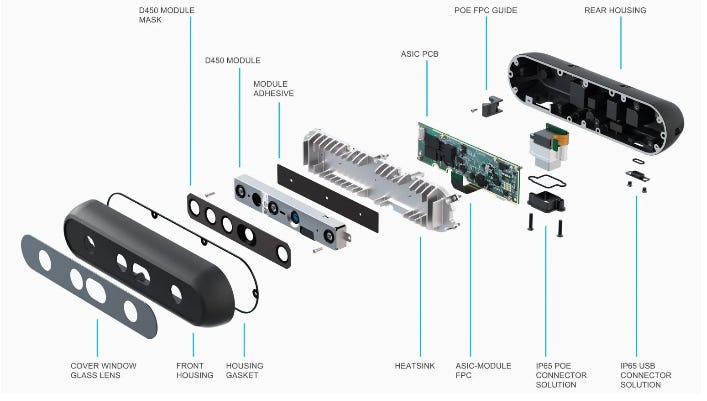
The hardware layer is accelerating alongside the software. The RealSense D555 PoE depth camera represents what purpose-built computer vision hardware looks like when designed from the ground up for physical AI deployment. Spun out of Intel in 2025 with a $50 million Series A, RealSense built the D555 around a new Vision SoC V5 processor optimized specifically for AI inference at the edge. A single Ethernet cable handles both power and data. The IP65-rated enclosure handles factory floors, outdoor environments, and conditions where consumer-grade hardware fails. It processes depth and spatial information at up to 90 frames per second, faster than the human eye can track, and integrates natively with NVIDIA’s Jetson Thor robotics platform for near-zero latency between perception and action. It sold out its first production run immediately.
These are not isolated product launches. They are signals of a coordinated infrastructure buildout. Visual intelligence is moving from research labs into warehouses, operating rooms, fitness equipment, delivery vehicles, and manufacturing floors. The question for business leaders is not whether this is real. The question is whether their organizations have a strategy for it.
The Window Is Measured in Months
The Cambrian explosion was not gradual. It was a threshold event. Once the conditions were right, the pace of diversification compressed what had taken hundreds of millions of years into an evolutionary instant. That is the nature of threshold events. They look slow from the outside until they do not.
Computer vision and spatial intelligence are at that threshold now. The convergence of capable perception hardware, advancing model architectures, and proven commercial deployments has created conditions for rapid expansion across industries. The organizations giving serious strategic attention to this now will hold the same advantage that early mobile adopters held in 2010. Not because they predicted every application correctly, but because they were already building institutional capability, vendor relationships, and operational experience when the window opened.
The right questions for your leadership team are not hypothetical.
They are immediate.
Where in your operations does spatial understanding matter? What decisions currently made by humans could be augmented by systems that see and interpret physical environments in real time? Which of your competitors is already exploring this, and what lead are you comfortable conceding?
Five hundred and forty million years ago, the ability to see transformed everything it touched. The digital version of that moment is not coming.
It is here.
The only question worth asking now is which side of it your organization intends to be on.
Richard Bukowski is a strategic foresight consultant specializing in Digital Realities: the convergence of technologies reshaping how humans live, work and make sense of the world and how people actually experience change. His work helps leadership teams see what is coming before it becomes an obvious competitive necessity.