

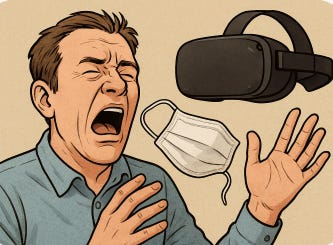
Remember that moment?
The second you stepped outside after your doctor’s appointment, your grocery run, your eight-hour shift, and you finally, desperately, ripped that mask off your face? That sweet relief of unobstructed breathing, of feeling air on your skin again?
That wasn’t just pandemic fatigue. That was your biology screaming what Silicon Valley refuses to hear: humans don’t want things on their faces.
Yet here we are, watching tech companies pour billions into VR and AR headsets, convinced they can engineer their way past millions of years of evolution. After decades of development and enough money to fund several space programs, no company has created a consumer headset anyone actually wants to wear. There’s a reason for that, and it’s not the technology.
It’s us.
We’re witnessing the collision between technological ambition and biological reality. Evolution spent millennia ensuring our survival depended on unobstructed senses. Our faces need to be clear to detect threats, read social cues, breathe freely, and maintain peripheral vision. This isn’t preference; it’s programming. COVID gave us the perfect natural experiment in facial obstruction tolerance, and the results were undeniable. Even with our health literally at stake, mask fatigue was universal.
Watch any security footage from 2020-2021: constant face-touching, endless adjustments, masks sliding below noses the moment authority figures looked away. We adapted to remote work within weeks, transformed our shopping habits overnight, but never, not once, got comfortable with covered faces.
Medical professionals train for years to tolerate surgical masks for extended periods. It’s learned behavior that fights against every natural instinct. The face isn’t just another body part; it’s our identity interface with the world. Covering it triggers psychological discomfort that no amount of features or functionality can overcome.
The technology world already knows this truth; they just refuse to apply it to headsets. Look at the clear pattern in every other domain of personal technology. Glasses evolved into contact lenses because people wanted their faces free. External hearing aids are rapidly being replaced by nearly invisible in-canal devices and cochlear implants. The military isn’t developing better headsets; they’re working on subdermal communication systems for aircraft carrier crews.
Even sunglasses, which actually protect our eyes, get ripped off the second we step indoors. The wearables that succeeded (Apple Watch, Oura Ring, Fitbit) all have one thing in common: they leave our faces alone. The trajectory is obvious. Technology succeeds when it moves away from the face, not toward it. Yet somehow, VR and AR companies keep insisting this time will be different.
The industry’s denial is becoming expensive and embarrassing. Microsoft laid off its entire Mixed Reality Toolkit team and shuttered AltspaceVR, essentially admitting defeat after years of HoloLens development. VRChat, arguably the most successful social VR platform, laid off 30% of its staff because even being the best isn’t good enough when the entire category is fighting human nature. Meta continues burning over $13 billion annually on Reality Labs with no path to profitability in sight. Apple’s Vision Pro, despite its impressive technology, is tellingly marketed as “spatial computing” rather than a VR headset (even they know the V-word is poison).
The U.S. Army’s HoloLens trials resulted in soldiers reporting nausea and disorientation; if trained military personnel can’t adapt, what hope does the average consumer have? Enterprise adoption works precisely because it’s mandatory and time-limited, just like surgical masks in operating rooms. Workers use AR headsets for specific tasks then immediately remove them. That’s tolerance, not adoption. Consumer markets require desire and comfort, and face-mounted computers provide neither.
The future I’ve been forecasting is already taking shape, and it respects our biological boundaries. Environmental computing will succeed where facial computing failed. Picture room-scale micro-LED surfaces that transform your living space into an immersive environment without touching your face. Smart homes evolving beyond voice assistants into spatially aware environments that respond to gesture and presence. Projection mapping that turns any surface into an interface.
Spatial audio that fills rooms without requiring headphones. This isn’t science fiction, it’s the natural evolution of computing that works with human nature instead of against it. Your home becomes responsive and intelligent while your face remains free. We’re already seeing this with smart TVs becoming computing platforms, with ambient displays providing information without demanding attention, with whole-room entertainment systems that create immersion through environment, not isolation.
Here’s my message to Big Tech: Just let it go. Stop fighting millions of years of evolution. Stop pretending that better optics or lighter materials will overcome fundamental biological resistance. The mask came off for a reason, and that reason is encoded in our DNA.
Sometimes our bodies or souls know things our ambitions don’t.
The future of immersive computing isn’t strapped to our faces, it’s built into our spaces. The next computing revolution will surround us, not suffocate us. Maybe that instinctive face-touching during COVID, that desperate need to pull the mask down for just a moment, was our biology trying to send Silicon Valley a message.
Perhaps it’s time they finally listened. Because no matter how much money they spend or how advanced the technology becomes, one truth remains: the face wants to be free.
The path for XR/VR/AR/MR/spatial computing-UI is clear, also for the companies spending a lot of money in headsets and glasses now: eventually the visual interface will or can be contact lenses. Also a great part of the human race already wear glasses when not sleeping without nausea or defying evolution. Please, keep on the path for VR with better and cheaper headsets and glasses for now, so more people can enjoy immersive and remote learning/training (by doing). And don't reject the shift to virtual reality...